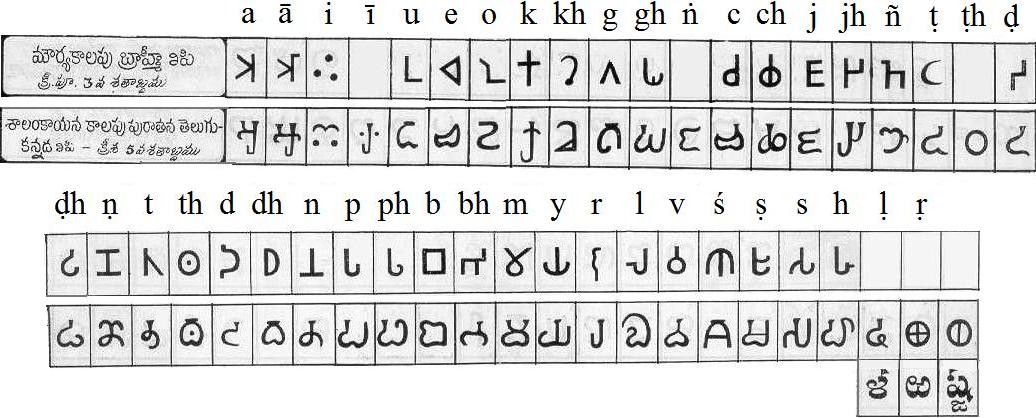
Kadamba script
| Kadamba script | |
|---|---|
 | |
| Script type | |
Period | 4–7th century CE[1] |
| Direction | Left-to-right  |
| Languages | Old Kannada Old Telugu Sanskrit Konkani |
| Related scripts | |
Parent systems | |
Child systems | Kannada-Telugu alphabet, Goykanadi,[2] Pyu script[3] |
| Brahmic scripts |
|---|
| The Brahmi script and its descendants |
The Kadamba script is the first writing system devised specifically for writing Kannada, and later adopted to write Telugu language.[4],Thus becoming precursor to both Telugu and kannada scripts.The Kadamba script is also known as Pre-Old-Kannada script.
The Kadamba script is one of the oldest scripts of the southern group of writing systems that developed from the ancient Brahmi script.The kadamba script which developed around 5th-7th century has evolved into the kannada-Telugu alphabet around 10th century, which is used to write both Telugu and kannada.
History
[edit]


During the rule of Kadamba dynasty (325-550), major change in the Brahmi script resulted in the Kadamba script, letters were shorter and round in shape. During (325 to 1000 AD) the rule of the Western Ganga dynasty in the southern parts of Karnataka the Kannada script used differently (also known as Ganga script) in rock edicts and copper plate inscriptions.
Inscriptions in Kadamba script
[edit]

- Gudnapur Inscription on 20-foot-long stone pillar written in Kadamba script[5]
- Copper plate inscriptions in Kadamba (Pre - Chalukya) script, Kadamba-Pallava script, Kannada-Telugu script are available at Chennai museum[6]
- Halmidi inscription
- Talagunda pillar inscription[7]
Similarity with other scripts
[edit]The Kadamba script shares similarities with scripts of certain languages belonging to the alphasyllabary or abugida family, including Goykanadi, Bhattiprolu script, Salankayana script,[8] Pallava script, Gupta script,[9] as well as its descendent, the Kannada script. [citation needed][original research?]

See also
[edit]References
[edit]- ↑ Diringer, David (1948). Alphabet a key to the history of mankind. p. 381.
- ↑ "Goykanadi script".
- ↑ Aung-Thwin, Michael (2005). The mists of Rāmañña: The Legend that was Lower Burma (illustrated ed.). Honolulu: University of Hawai'i Press. ISBN 978-0-8248-2886-8.
- ↑ Diringer, David (1948). Alphabet a key to the history of mankind. p. 381.
- ↑ Rajiv Ajjibal (16 December 2011). "Monuments crying for attention". The Hindu. Archived from the original on 29 October 2013. Retrieved 13 March 2014.
- ↑ "Government Museum Chennai". Chennaimuseum.org. Retrieved 13 March 2014.
- ↑ "Kannada inscription at Talagunda may replace Halmidi as oldest". Deccan Herald. 12 January 2017.
- ↑ "Comparison of Brahmi and Pallava scripts". SkyKnowledge.com. Retrieved 14 December 2025.
- ↑ "Gupta". Ancient Scripts. Archived from the original on 7 March 2020. Retrieved 13 March 2014.